
Portland Previous Residents by Era
Different records answer different parts of a Portland address history. A recorded deed documents parties and a legal description. A reverse directory can show the person or business printed at an address in a given year. A census can add a household view after the federal release period. The cleanest method is to follow the source appropriate to the date, not to flatten all of these records into one claim about who lived at a place.
| Source | Years it covers | Where held | What it adds |
|---|---|---|---|
| MultCoRecords documents | February 2002 to present online | Multnomah County recording portal | Party, document type, date, number, and legal description. |
| DART recorded index | 1965 to present | Public terminals at 501 SE Hawthorne | Index searching beyond the online document cutoff. |
| DART microform and County Archives | Predates web systems; earliest deed book 1849 to 1854 | DART and archives by appointment | Earlier conveyance and county-history evidence. |
| Portland reverse city directories | 1930 and later | Central Library | Annual address-to-listed-person or business clue. |
| Portland alphabetical directories | 1863 to 1929, plus later volumes | Central Library | Name-first bridge where no reverse section exists. |
| Federal census | Released under the 72-year rule | National Archives and census genealogy channels | Decennial household composition, subject to access rules. |
Start with the current parcel when the address is known. Start with a name when the address is from before 1930. For an early territorial question, the Oregon State Archives and County Archives route can be more useful than an online search. The County's historic property and records research information describes the official local channels that sit behind this era map.
Use the channel named for the era, and preserve the source's own label for each party or address field.
Portland Previous Residents Start at the Parcel
For a Portland property in Multnomah County, use PortlandMaps to identify the site and parcel context, then use MultCoPropTax to record the Property ID, situs address, owner shown, legal description, tax year, and any mailing address. The guest search accepts a property account number or street address. Its basic and advanced routes also support name, legal description, alternate account number, map tax lot, city, and ZIP fields. These are property-record fields, not a past-resident list.
The baseline matters because address numbers can change, subdivisions can shift, and a unit can be added later. The situs is the physical location of the taxed property. A mailing address is where tax correspondence goes. The legal description is the recorded lot, plat, or other parcel identifier that keeps the chain connected even when the street form changes. An assessed owner is not automatically the person who occupied the address, so retain those labels exactly as the county displays them.
- Situs address
- The physical location of the taxed property.
- Mailing address
- The tax correspondence destination, which can belong to an agent, business, trust, or owner elsewhere.
- Legal description
- The lot, plat, or recorded property identifier used to test whether two instruments concern the same land.
Tracing Portland's Multnomah Deed Chain
Once the parcel baseline is set, open the most recent recorded transfer in MultCoRecords. The official result can show party name and type, document number, document type, recording date, legal description, and an image or order path. Use the document and legal-description fields to test each step. A deed's seller is the grantor, and the buyer is the grantee. To move backwards, look for the seller from the newer deed as a grantee on an earlier acquisition, then repeat only when the legal description continues to match.
- Copy the current Property ID, situs address, and legal description from the parcel account.
- Search the current owner or the relevant date range in MultCoRecords and identify the newest deed or other transfer.
- Record the document number, document type, recording date, party roles, and legal description before leaving that result.
- Search the prior owner as a grantee to find an earlier acquisition, then compare the legal description again.
- Move to DART terminals, an image order, microform, or County Archives research when the online coverage ends.
- Grantor
- The party transferring an interest in a recorded instrument, often the seller on a deed.
- Grantee
- The party receiving an interest, often the buyer on a deed.
- Chain of title
- The sequence of recorded transfers tested through parties, dates, document references, and the same legal description.
The MultCoRecords portal is the online starting point for the modern portion of this Portland previous-residents trail.
The portal result is an index and ordering path, not a finding that every named party lived at the property.
Portland Deeds Before Online Search
MultCoRecords makes recorded documents from February 2002 onward searchable online, but that is not the start of the county record. DART's public terminals carry electronic recorded indices from 1965 forward. Earlier materials are on microform or through archives research. Deeds after December 31, 2001 can be printed from home, while older images require an order through DART Customer Service or viewing and printing on lobby computers. County Archives research requires an appointment, and its stated phone is 503-988-3741.
The Multnomah County records and archives information helps set expectations about appointments and older-record access.
Bring the most recent name, document clue, and legal description when a Portland previous-residents search moves off the web portal.
The Oregon State Archives Multnomah guide adds an early-record route: an 1854 to 1859 deed index with grantor, grantee, book, and page, as well as 1856 to 1859 probate material. The County's oldest archival deed book spans 1849 to 1854 and concerns land then administered in Washington County, so a deep Portland ownership trail can cross a county-history boundary.
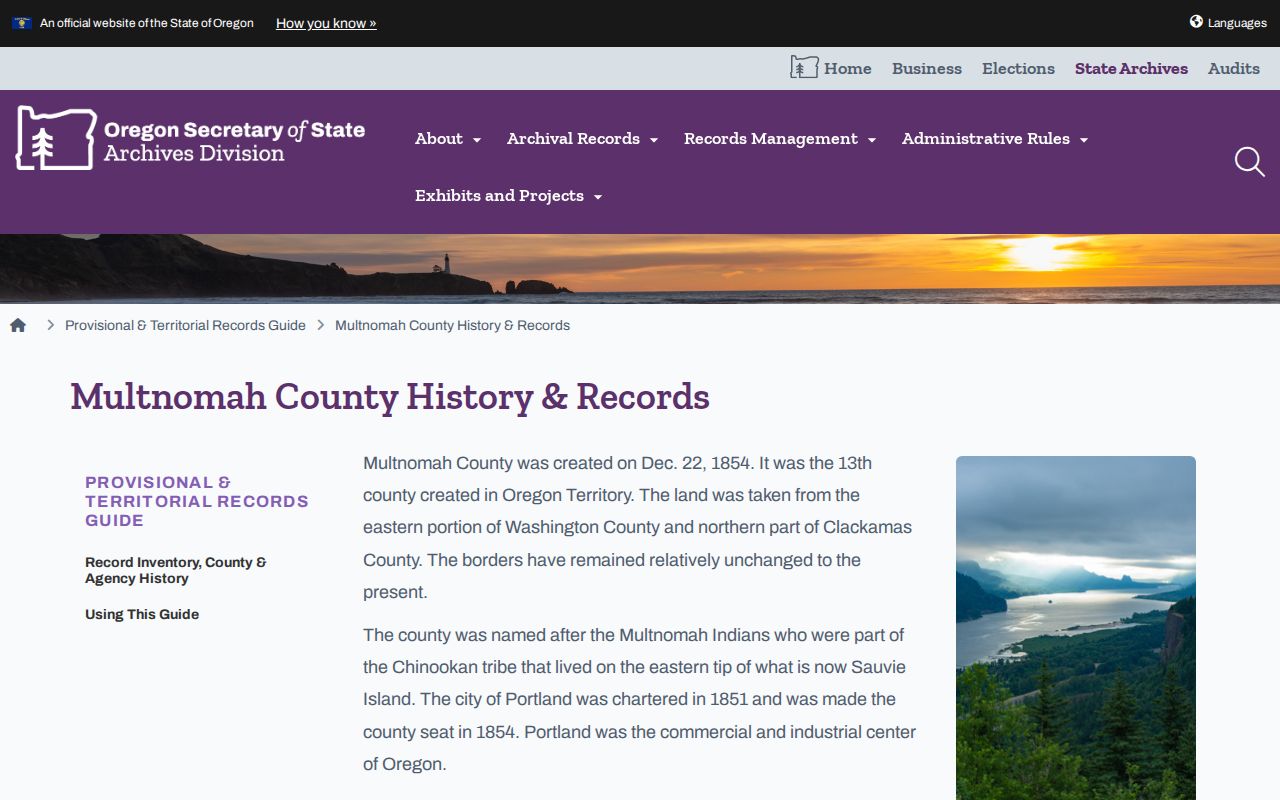
That early geography is a reason to check the stated jurisdiction and book reference before deciding that a Portland property has no earlier deed trail.
Portland Previous Residents in Reverse Guides
Deeds trace recorded property interests. Portland's reverse Street and Avenue Guides add a separate annual clue about the person or business listed at an address from 1930 forward. Find the street, block, and number in the reverse section, then read the matching alphabetical entry. The alphabetical part can add a home address, trade or business notation, a spouse's first name in parentheses, or a widow notation. Treat the listing as an edition-year clue. It neither proves ownership nor accounts for every person in a home.
For a more complete account of the volumes and their reading conventions, use the Portland city directory collections. That historical shelf is the better place to compare publishers and collection structure; the reverse guide is only one step in reconstructing past residents at one address.
Note: A match grows stronger when the directory year, address form, and a second dated record point to the same person rather than merely the same surname.
Portland Previous Residents and 1933
Portland's citywide address revision began in 1931 and was completed in July 1933. Nearly every building received a new number and directional, and many streets changed names. A house-history search that uses only the current address can therefore miss the very directory or deed reference it needs. The Crane Directory of Street and Name Changes bridges the old and new forms in both directions. Search the old form for 1930 to 1931, and search both forms for 1932 to 1933 because the timing varied by neighborhood.
Annexation can create a second break. A neighborhood that is Portland now may have been outside city limits when a house was built, and the appropriate historic source can be rural or Gresham rather than a Portland directory. Retain old street names, directional fields, and city labels as evidence instead of silently converting them to the current form.
Portland Past Residents in Census Records
For household-level history, pair annual directory clues with federal census releases available under the 72-year rule. The directory can show a name at an address in one edition. The census offers a decennial view of a household, subject to its own indexing and release limits. Historic newspapers then help test a dated address or name. Multnomah County Library points researchers to Historical Oregonian for 1861 to 1987 and Oregon Journal for 1902 to 1982, including quoted address searches and obituary, advertisement, and local-news context.
Cancelled voter registrations are another narrow historical-presence source, not a live-neighbor tool. Multnomah Archives retains cancelled registrations beginning in 1908, through 2006 as described by the County, and signatures cannot be copied under ORS 247.973. The County voter-registration records guide identifies the official route and its limits.
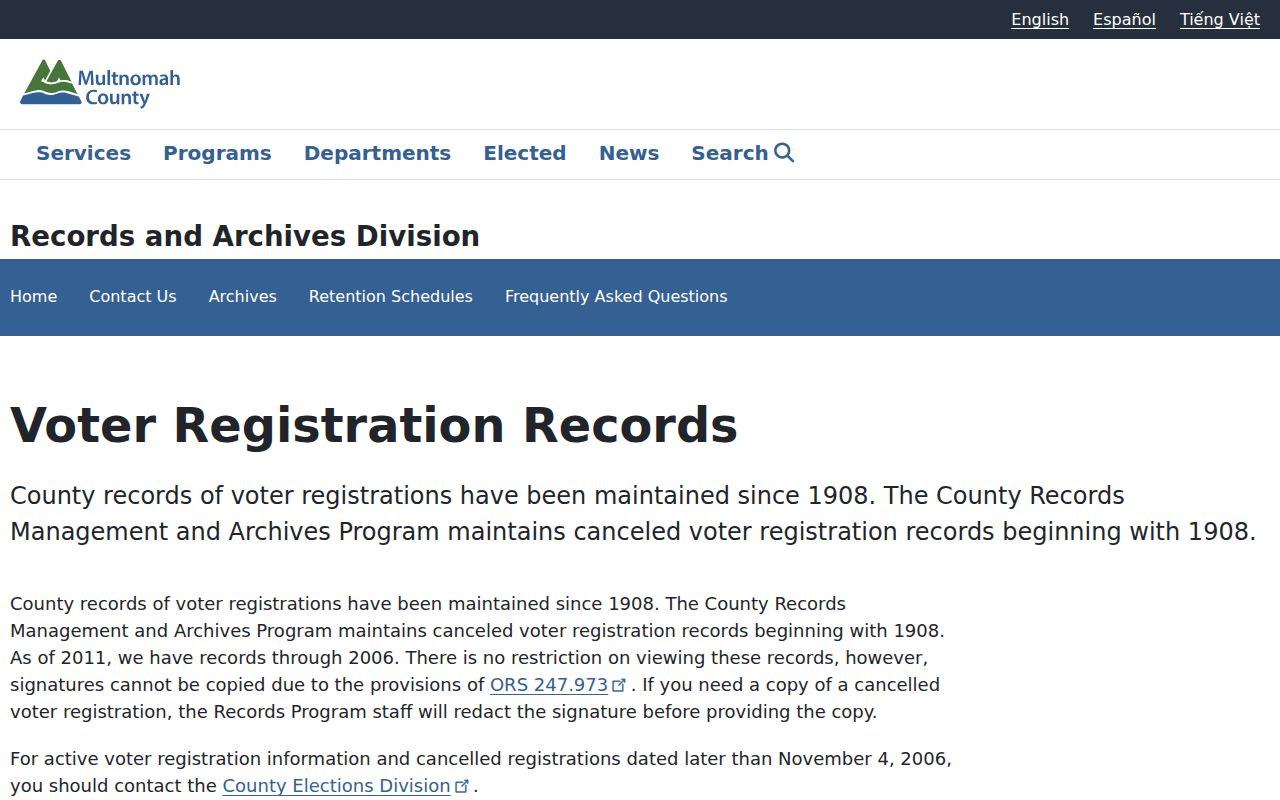
Use a cancelled-card lead to guide archive work, then confirm the year and address through the directory, census, deed, or other record that actually supports it.
Portland Previous Residents and Probate
A household trail may end with an obituary, an estate instrument, or a public probate case, but those sources have their own access boundaries. Multnomah Circuit Court files and probate are held by the Oregon Judicial Department, not County Archives. A public court register can distinguish records by court, dates, parties, and role, while confidential or sealed material remains unavailable. Use a court or recorder record only for the documented relationship it supports, and stop when the trail becomes restricted or uncertain.
For property-record awareness, Multnomah's free Property Recording Alert Service sends same-day email when a document is indexed under monitored identifying information. It does not prevent fraud or guarantee that a document is legitimate. It can prompt a person to inspect a new official entry, not replace a deed-chain review.
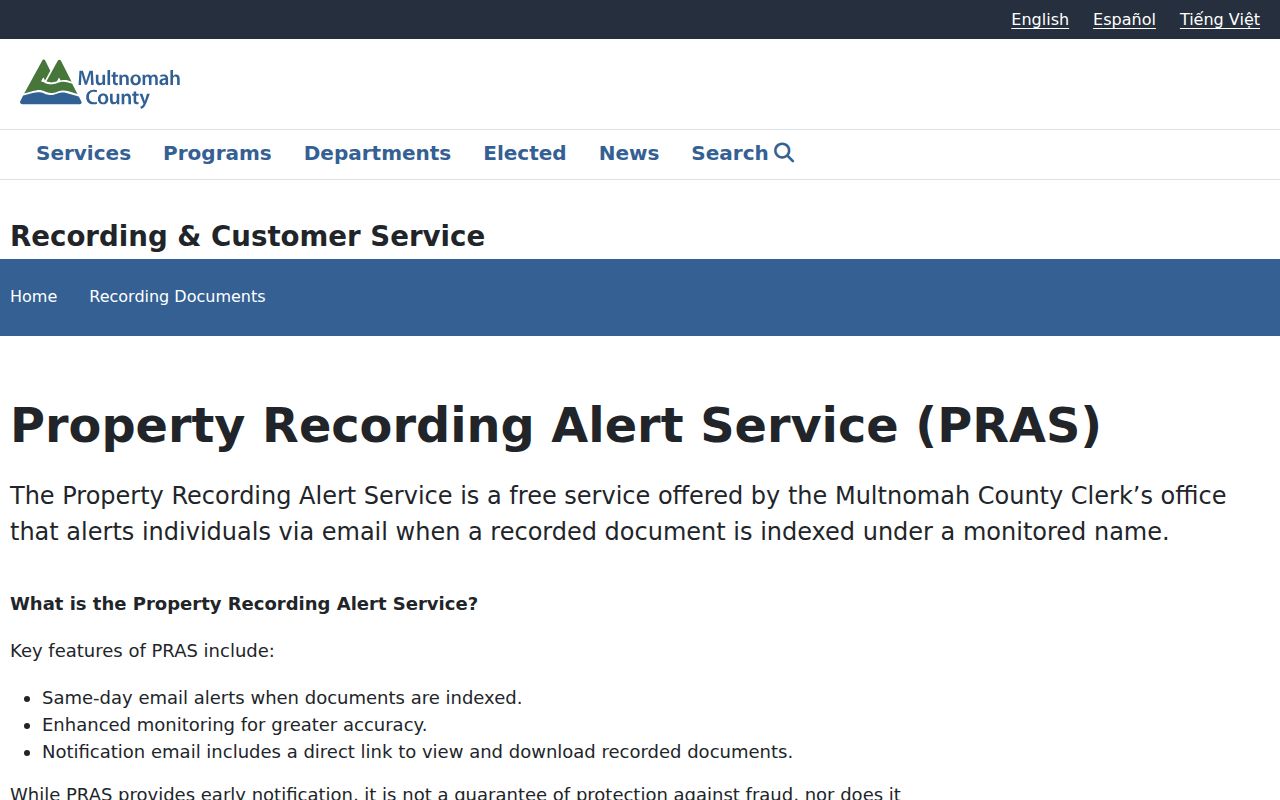
The alert service belongs alongside careful document review when a past-residents search has reached the recorded-property portion of the history.
Lawful use. Portland previous-residents research is suited to family history, house history, estate questions, and civic record work. Oregon law prohibits stalking and harassment, so do not use historic or current records to track, contact, or harm a living person.